In the Fields / feature
Texas Ramp Project
What a Front Door Can Make Possible
The Texas Ramp Project turns a precise home modification into access to the wider world.
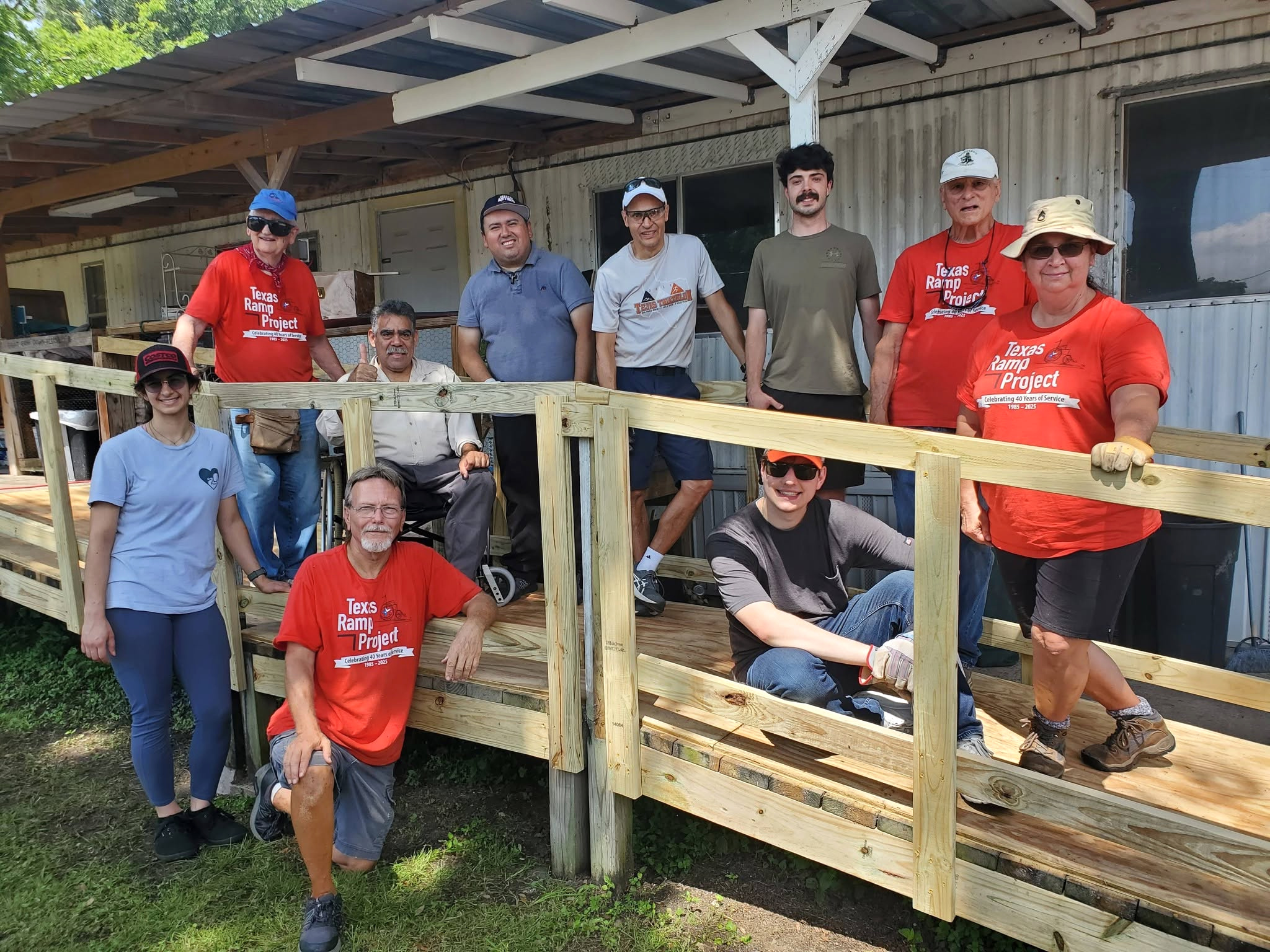
The work, made visible
A way out. A way forward.
The organization’s 2025 review shows the scale of a practical idea: neighbors building access for neighbors.
2025
2,930Ramps built statewide
Completed ramps reported in the May 2026 annual review.
Texas Ramp Project · 2025 year in review2025
25,561Volunteers engaged
Reported engagement across partner organizations. Source does not establish whether this is a deduplicated count of individual people.
Texas Ramp Project · 2025 year in review2025
621Community and corporate build events
Completed build events, separate from number of ramps.
Texas Ramp Project · 2025 year in reviewHow the work connects
Identify the barrier
A referral begins with someone who needs safe access at home.
Bring a team
Volunteers and partners organize materials, time and construction.
Build the connection
A completed ramp connects the front door with the world outside.
All figures are from the 2025 year in review. Volunteer engagement is reported as published; it is not identified as a count of unique people.
How to read these numbers
These figures describe the organization’s reported activity or service reach. Each keeps its own reporting period and definition. They are not a ranking, a count of identical outcomes, or a promise of what a particular gift will buy.
The Short Version
Volunteer teams build free wheelchair ramps for people with medical and financial need, connecting local referrals, materials and construction across Texas.
A small distance with large consequences
The distance between a front door and the sidewalk can determine whether leaving home is practical at all. For someone using a wheelchair or walker, steps can become a daily barrier to appointments, visits and ordinary time outdoors. Texas Ramp Project focuses its charitable work on that specific obstacle: a safe route into and out of a home.
The organization provides ramps without charge to eligible people who have both medical and financial need. Volunteer construction is central to the model. The visible result is timber and a new path; the purpose is greater access. That combination makes the organization particularly legible to a prospective supporter: there is a defined problem, a practical intervention and a person whose ability to use their home is at stake.
From one local request to a Texas network
The roots reach back to 1985, when members of the Kiwanis Club of Richardson were asked to build a ramp for a friend. The work grew into the Dallas Ramp Project. In 2006, the Texas Ramp Project incorporated to bring the approach to other parts of the state. Its history page now describes regional operations stretching from the Panhandle to the Rio Grande Valley and from East Texas to El Paso.
Expansion depends on local participation. The organization works with civic groups, churches, businesses and other volunteer teams. A statewide identity therefore rests on people who know their own communities, can organize a build and can keep the necessary materials close at hand. For a company or community group, a relationship with the nearest regional team can be more useful than a single isolated service day.
The work before construction
A ramp begins with a referral. Texas Ramp Project's current instructions require a qualified organization or professional to make that referral; individuals and families are directed to contact a healthcare provider, social worker or community organization. Medical necessity, financial hardship and service-area coverage are part of the process.
The organization describes a site visit and design stage before construction, followed by a crew led by a trained volunteer. That preparation is consequential. The home, the entrance and the person using the ramp are specific to each request. A repeatable service model still has to fit an individual setting. The referral and survey work help turn a general willingness to help into an appropriate project.
What giving puts in motion
The official donation page identifies lumber and tools among the uses of contributed funds and offers one-time or recurring gifts. It also invites people to serve as builders and local leaders. Money and volunteer participation address different parts of the same process: purchased materials need a prepared team, and an available team needs supplies and a suitable project.
Capacity varies by place. The ramp-request page warns that waiting times depend on referral volume and local volunteer availability. Prospective donors should ask where the greatest gaps are and whether support for materials, storage or organizing would help the relevant region. The organization's published financial documents provide another starting point for understanding how resources are managed.
Access as an everyday outcome
Executive Director Mark Denzin leads the staff. Sandra J. Knutson is Director of Administration, and Mark Hinzman serves as interim board president and vice president, with corporate relations and strategic partnership responsibilities. Prospective supporters can contact the organization to discuss giving, regional partnerships or the responsibilities involved in volunteering.
The purpose of a ramp extends beyond the day a crew completes construction. It creates a usable connection between a person's home and the life outside it. A medical visit, an afternoon with family or time on the porch each begins with that access. The project's strength is its practical focus: local people organize around a specific barrier and leave behind something a household can continue to use.
The people behind the work
Leadership & contacts
Select a person’s card to open their official leadership page. Public roles and contact routes reviewed 2026-10-12.
Mark Denzin
Executive Director
Open leadership sourceSandra J. Knutson
Director of Administration
Open leadership sourceMark Hinzman
Interim President and Vice President; Corporate Relations & Strategic Partnerships
Open leadership sourceConnect with the organization
info@texasramps.org214-558-0339Contact the organization ↗Use the organization’s public contact route for profile inquiries, partnerships and introductions.
More than one way in
Bring what you can.
Help beyond the build
Texas Ramp Project also invites volunteers with administrative, marketing, IT and grant-writing skills.
standing volunteer request · checked 2026-10-13 · SourceParticipation routes checked October 13, 2026. Contact the organization for current availability and requirements.
Where the work reaches
Selected counties from the published roster dated December 9, 2025; not a complete list. Availability depends on local volunteers, funding and the referral process.
Bosque, Hill, McLennan, Falls, Freestone, Limestone, Bell, Coryell, Brazos, Burleson, Grimes, Madison, Robertson, Washington, Bastrop, Travis, Caldwell, Hays, Williamson, Dallas, Collin counties.
Check the organization’s geography ↗Put generosity within reach
Give directly.
Stay connected.
Official giving page links to its Donorbox campaign and provides mailed-gift instructions. Ramp referrals must come through an eligible professional or organization.
Give to Texas Ramp Project ↗Your gift is handled by the receiving organization. UNSUPERVISED* does not process it or take a percentage.Go to the source
Read further.
Organization-published sources, reviewed 2026-10-12.