UNSUPERVISED* / RECOVERED / Family film
Together Again.
For the lives history overlooked.
Visual Genealogy. Historical Reconstruction.I imagined a train station at the edge of Heaven, where Jessie Quenile Walker finds her daughter, Tennie Lee Smith Anderson. Then Tennie’s son, my grandfather Billy Guy Anderson, arrives in his number 14 uniform. I gave them a moment together that no camera could have recorded.
Beyond the Film · The Full Illustrated Essay
I Want to Know the Leaves.
Explore the people, photographs and family history behind Together Again in the full illustrated essay by Clayton Hollingsworth.
6 minute read · Family photographs and archival records
Read the Full Illustrated EssayWhy I made this
I’m still listening.
I made Together Again for the people whose lives rarely made it into the history books. In my family, that has often meant women. I can find a marriage, a child’s birth, a death. I want to know the woman who lived between those entries.
My great-grandmother Tennie helped give this work its purpose. The thought of her being forgotten stayed with me. As I follow her family further back, I keep finding people I wish I could sit beside and hear for myself.
This film is also for anyone who lost their voice, or learned that speaking came at a cost. I want you to know I’m listening. It takes courage to keep going when nobody seems to hear you, and I believe hope still has a place in this world.
The reunion is my imagining. Jessie, Tennie and Billy Guy were real people, connected by family. I’m telling their stories because their lives deserve more room than the dates on a stone.
The care behind the work
The responsibility behind the photograph.
Now, don’t get me wrong, a decent filter can do a body good. I’m guilty. But when I’m working with history, I have a duty to be faithful to reality, even when that reality is inconvenient.
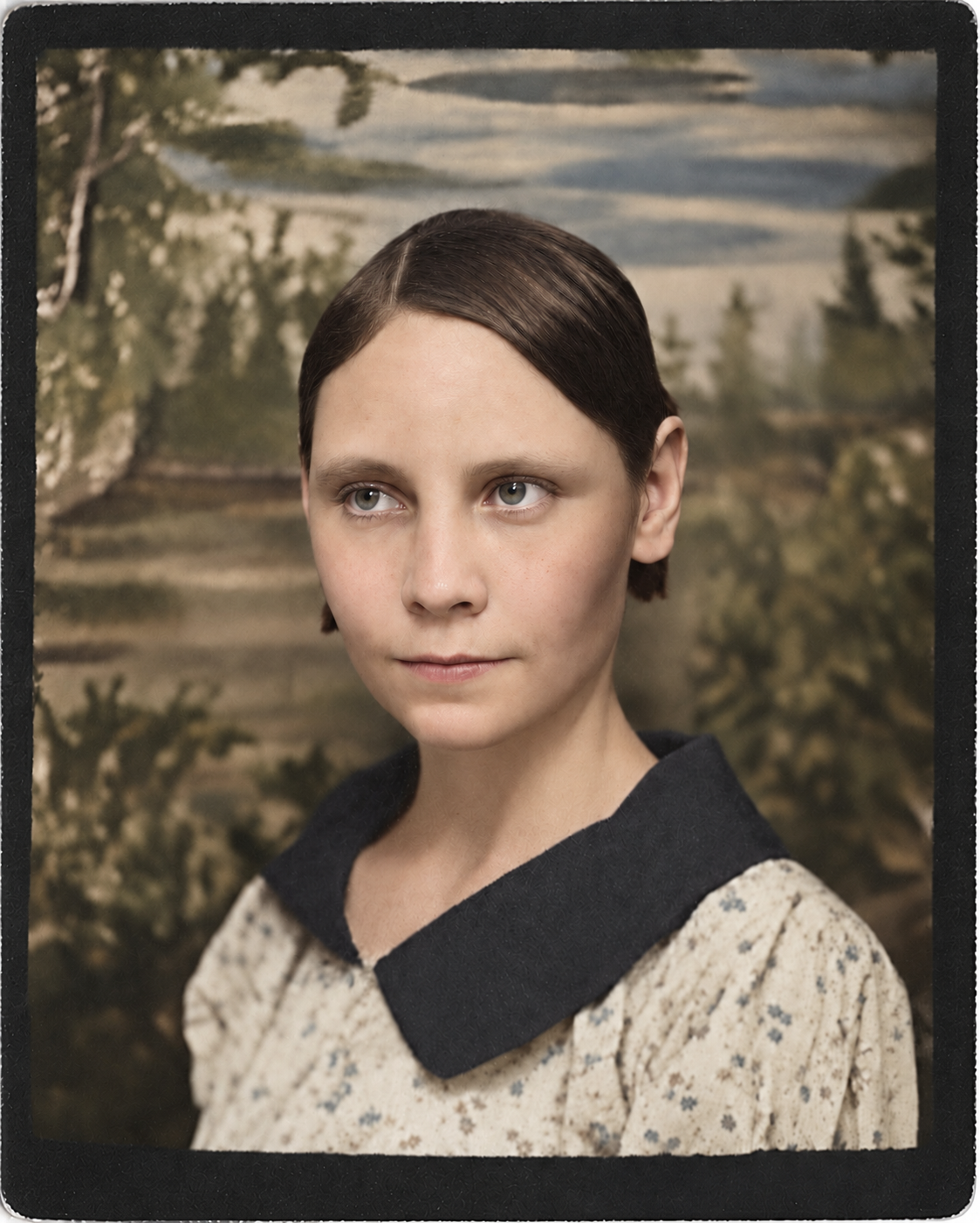
I work on these photographs because the people in them matter to me. That makes preserving their likeness part of the job. I keep the supplied source and check each treatment against it. Any detail supplied by reconstruction is an interpretation; it cannot become evidence just because it looks convincing.
I’ve put two digital treatments together so the differences can be seen in one photograph. The source I received had already been restored. I keep that version as a reference, because a convincing result still needs to be checked against what I actually have.
A few words worth knowing.
- Identity drift
- When a face gradually stops looking like the person in the source photograph.
- Cumulative artifacts
- Small mistakes that build up as each generated version becomes the starting point for the next.
- Mottling
- Uneven, blotchy patches of tone or color that can make skin look patchy or dirty.
- Hallucinated texture
- Detail the model supplies without support from the source, such as invented pores, wrinkles or fabric patterns.
Fine pores and lines are called microtexture. If a new pass adds lines to a face, I go back to the clean reference. I’m not giving an ancestor a fresh set of wrinkles just because a program decided they looked convincing.
Further reading: Repeated image editing · Image authenticity

Continue Reading · The Full Illustrated Essay
I Want to Know the Leaves.
Explore the people, photographs and family history behind Together Again in the full illustrated essay by Clayton Hollingsworth.
6 minute read · Family photographs and archival records
Read the Full Illustrated Essay