The Unpresidential Library / The Trump Wing / Opinion & satire
The Five-Day Administration.
Katie Zacharia’s brief tenure raises a longer question about the president who hired her.
By Clayton Hollingsworth · · 5-minute read
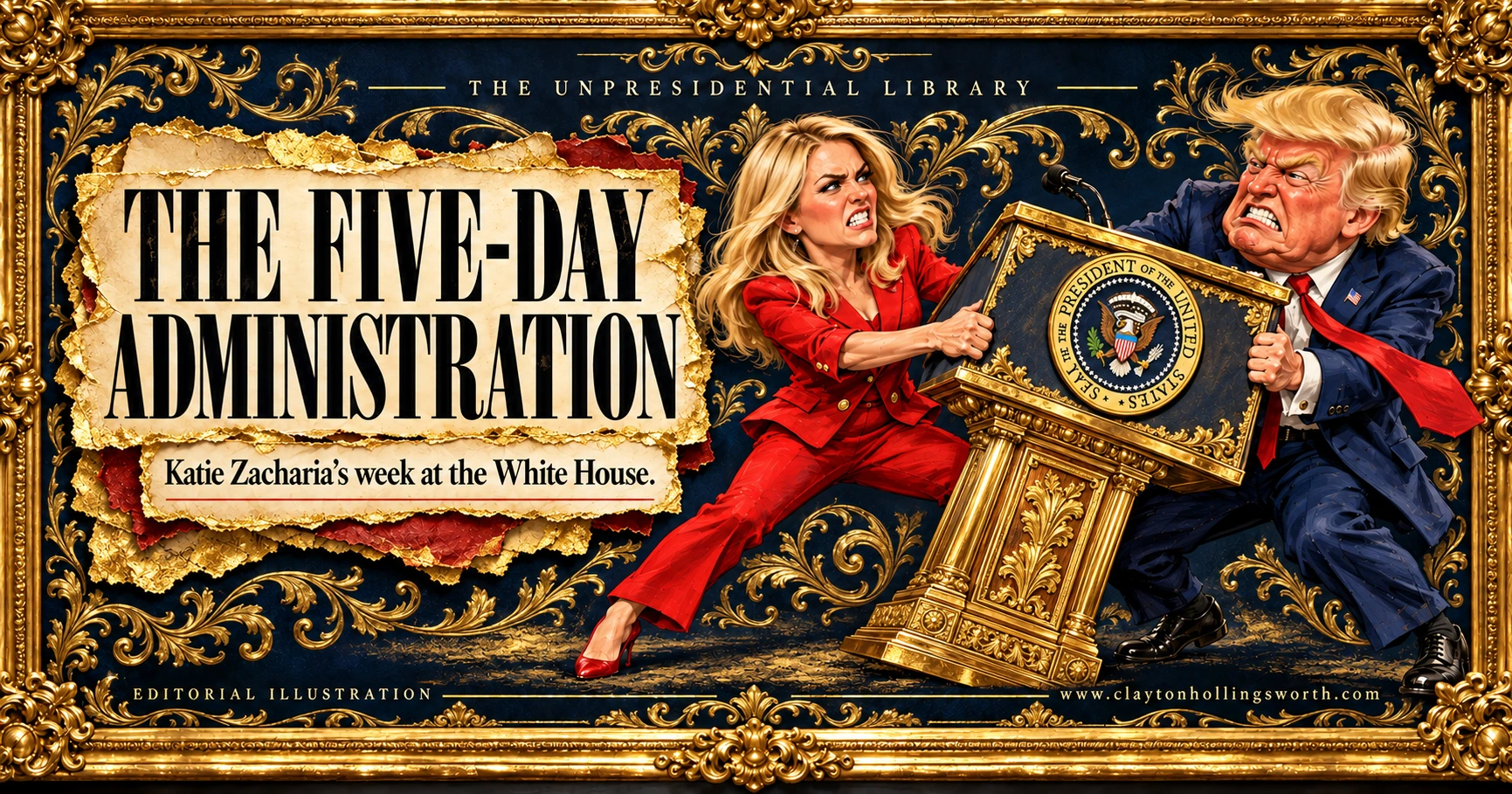
The Unpresidential Library has acquired a personnel file so thin it barely needs a folder.
Katie Zacharia began work as White House press secretary on Monday, October 12. By Friday, October 16, she was leaving. Her appointment had been announced October 9: a week between announcement and exit, five calendar days in the job. [1][2]
There are leftovers in my refrigerator with a more established tenure.
The obvious exhibit is the abbreviated employment history. The more revealing exhibit is what the White House said in between.
On October 13, the administration issued a release celebrating Zacharia’s first briefing. Its headline described the debut as “Powerful”; the opening sentence called it “commanding.” Three days later, Reuters reported that officials said she had been fired. Trump publicly framed the situation as a suggestion that she reconsider the job. [1][3]
That is quite a journey for an institution’s assessment of its own hiring decision.
Preserve the release. Put it beside the departure reporting. Give visitors enough room to stand back.
When an administration praises a debut and then loses its spokesperson before the week ends, the question reaches beyond the person at the microphone. What did the people making the appointment believe they had hired? What changed? And how much of the surprise should have been preventable?
Those are management questions. They remain management questions when the office has a presidential seal.
Zacharia’s debut lasted about fourteen minutes. The Associated Press reported that she said she had not been fully briefed beforehand and wanted to leave time for Trump’s own appearance. That explanation deserves space in the record. A new employee’s preparation is part of the employer’s responsibility. [2]
Anyone who has hired people knows the distinction between recognizing potential and preparing someone to succeed. Enthusiasm matters. So do judgment, experience, accurate information, and a realistic understanding of what the position requires. A competent hiring process should test those things before the new employee becomes the organization’s most visible representative.
The briefing room is a particularly expensive place to discover that the expectations were unclear.
Questions about Zacharia’s legal credentials also dominated the week. Reuters reported that she acknowledged in a Fox News interview that she had not passed the bar exam. [1] A law license is not the qualification I would demand of a press secretary. I would demand clarity about the qualifications being presented, and an ability to answer foreseeable questions without making the uncertainty larger.
The distinction matters. Failing an exam is a human experience. Hiring someone for a prominent public position creates an institutional obligation to understand the résumé, prepare for scrutiny, and explain the choice.
I don’t need to turn a woman’s very public bad week into a character diagnosis to question the judgment of the president who selected her.
Nor does the short tenure, by itself, prove that ending it was the wrong decision. Sometimes an appointment fails. Responsible leaders should correct mistakes promptly. Keeping someone in a role that is not working merely to avoid embarrassment serves nobody.
But correcting a hiring mistake does not erase the hiring decision. It should produce an explanation and a better process. Otherwise, the organization simply reaches for another nameplate.
That is where the accountability belongs. The public can reasonably ask what standards governed the selection, what support accompanied it, and what will be different when the next person walks into the room.
The temptation is to treat the entire episode as a competition in short service. Anthony Scaramucci inevitably enters the conversation. For the museum label, however, his job was White House communications director, a different position. [1] A joke improves considerably when the nouns are correct.
We should also resist letting the comedy consume the purpose of the office.
A press secretary helps explain decisions made in the public’s name. Reporters need someone who can distinguish an answer from a promise to find one, correct a mistaken statement, and remain useful when the questions become uncomfortable. Citizens need information they can assess, including citizens who did not vote for the president.
That work requires credibility. Credibility grows through preparation, accuracy, and a willingness to acknowledge limits. An employer who wants it must value those qualities during the selection process and support them after the cameras turn on.
The White House’s celebratory release is useful precisely because it records an institutional judgment in real time. It lets us compare the administration’s public confidence with the outcome, without inventing a private conversation or pretending to know everything that happened behind the scenes.
This exhibit can therefore remain mercifully compact: the appointment date, the praise, the exit, and a question for the next vacancy.
Who is responsible for making sure the next person is ready?
Five days tells us how long Katie Zacharia held the job. The answer to that question will tell us whether anyone learned anything.
The source record
A week, on the record.
- Appointment announced. [2]
- First day in the role. [2]
- First briefing and official White House praise. [3]
- Departure reported; Trump says he advised reconsideration. [1]
All dates are in 2026. Reuters reported a firing based on officials’ accounts; Trump’s public characterization is identified separately.
Sources & further reading
- Reuters · October 16, 2026 ↗
Departure reporting, Trump’s public explanation and the bar-exam acknowledgment.
- Associated Press · October 16, 2026 ↗
Appointment and start dates; Zacharia’s account of preparation for the briefing.
- The White House · October 13, 2026 ↗
The administration’s own assessment of her debut; includes a link to the briefing video.
Sources checked October 17, 2026. This is a sourced opinion essay; the museum jokes and illustration are satire.