24 October 2026 · Clayton Hollingsworth
Reading Daniel Perry Beyond the Obituary
A flattering tribute leaves difficult questions about arrival dates, slavery, and what a family history owes its subjects.
An obituary can give a family a great deal to work with. It can also give us a great deal to question.
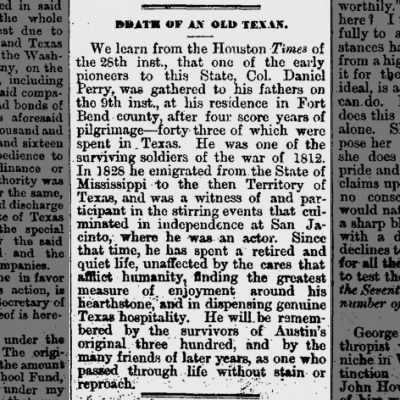
The surviving notice headed “Death of an Old Texan” remembers Daniel Perry as a pioneer, a surviving soldier of the War of 1812, and a participant in the events leading to Texas independence. It praises his hospitality and domestic life. At the end, it offers a judgment that deserves to be read slowly: he passed through life “without stain or reproach.”
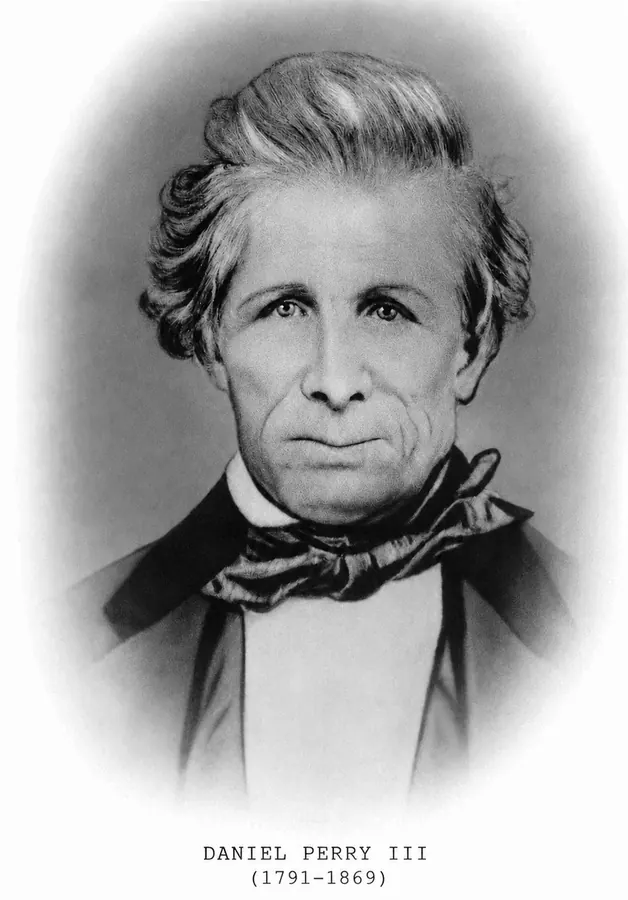
Daniel Perry is my ancestor. That relationship is a reason to examine the account carefully. I do not want to discard a difficult source, and I do not want to mistake a tribute for a complete life.
Start with the chronology. The clipping explicitly says he emigrated from Mississippi in 1828. It also says forty-three years of his life were spent in Texas. If the notice belongs to 1869, those statements do not fit together. Forty-three years points to approximately 1826; arrival in 1828 would leave approximately forty-one years.
That discrepancy does not tell us which statement is wrong. It tells us there is something to investigate. A printing error, copying error, confused recollection, or a more complicated migration could explain part of it. None of those possibilities should become the answer simply because it would make the timeline easier to write.
Other records add to the difficulty. The March 1838 Fort Bend headright certificate states June 1832 as an arrival date. A probable match in Austin’s family register gives December 1830, with a related January 1831 certificate notation. The identity and meaning of each entry matter. First physical entry, settlement, and an arrival date used in a land claim may not be the same event. At present, earlier or repeated journeys remain hypotheses.
I questioned whether we had dismissed 1828 too readily. That question belongs in the story because family research can become overconfident in either direction. A date cut into a historical marker feels settled. A date printed close to a person’s death feels authoritative. Both still have to be traced to evidence and examined in context.
The obituary’s closing praise presents another challenge. Our working research includes a transcription of the 1850 slave schedule listing four people held in slavery under Daniel Perry. The original schedule and further records are needed to recover their identities and histories more fully. Their presence cannot be left outside an account of the man the obituary calls beyond reproach.
Who was entitled to offer that judgment? Whose experience counted in it? A reputation for hospitality among neighbors could coexist with the denial of other people’s freedom. The tribute tells us something about the community that produced it, as well as the person it mourned.
The work now is to follow those questions into records: the original newspaper and its reprint history, the land instruments, the historical marker’s research file, probate, and the people named or left unnamed in those sources. The search for the old Perry Place and Daniel’s burial ground belongs to that same effort. A family story has places on the ground, but finding a place does not by itself resolve everything that happened there.
Later that day, I tested another familiar source. A drawing on page 117 of Hubert L. Perry’s family history locates Daniel and James Perry’s homes and traces Santa Anna’s march through Fort Bend County in April 1836. I wanted to see what happened when we placed it over the 1882 county map we had been studying.
The lines did not agree consistently. Some survey features could be brought into a reasonable fit; others drifted. Our alignment was approximate, and the county map was made forty-six years after the events Hubert described. The discrepancies gave us questions for original surveys and deeds.
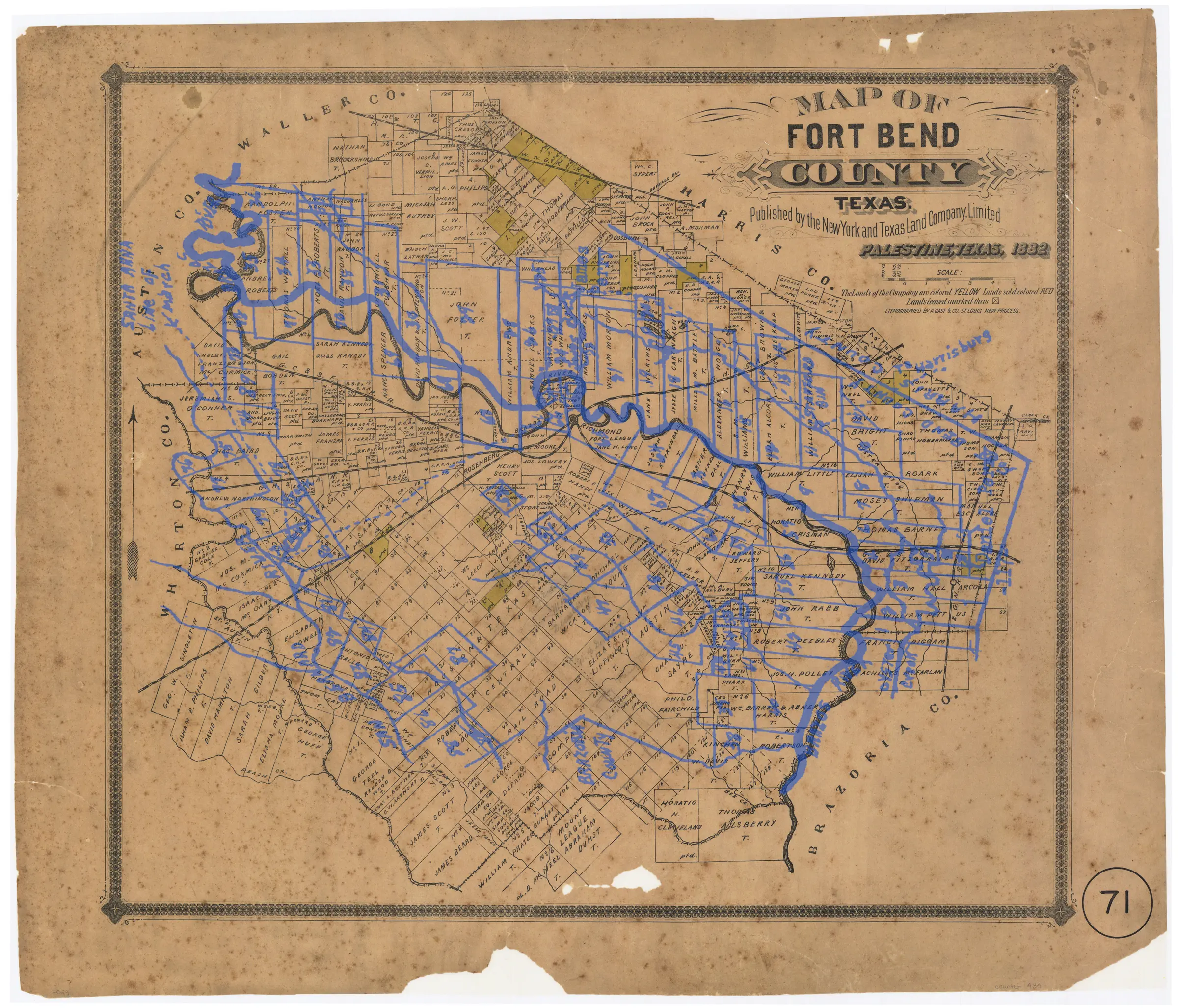
My first reaction was that we had caught mistakes others might have inherited. I had to hold that conclusion open, too. We had exposed a mismatch; we had not yet established which map was wrong or who had relied on it. On the preceding page, Hubert wrote that Santa Anna crossed James Perry’s land and added, “I am sure” every building was burned. That was his inference. The overlay could not turn it into a documented fire.
A published page can guide the next search and still need correction. The research should leave a trail that shows what changed and why, including the occasions when the assumption that needs revisiting is mine.
I want a biography that can hold what is documented, what remains uncertain, and what a flattering notice leaves out. The obituary is an important part of that work. Reading it closely gives us the questions that the rest of the story must try to answer.